Quick Answer
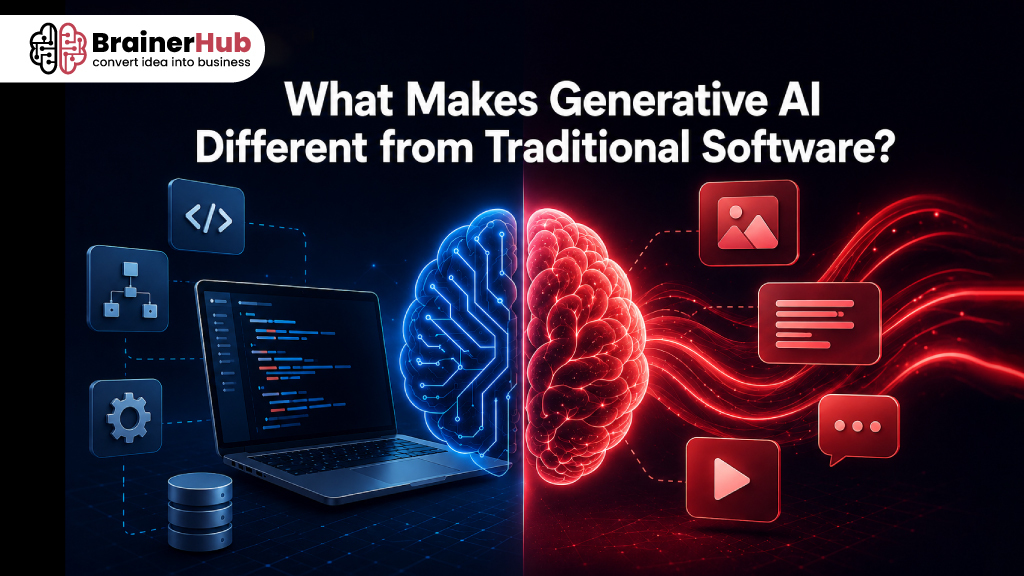
Generative AI differs from traditional software because it creates new content and understands natural language instead of simply following predefined rules. Traditional software executes programmed instructions to produce predictable results, while Generative AI learns patterns from large datasets to generate dynamic, context-aware responses. Together, they enable businesses to automate workflows, improve productivity, and deliver smarter user experiences.
Key Takeaways
- Traditional software follows predefined rules and delivers consistent, predictable outputs.
- Generative AI understands context and generates new content based on user prompts.
- Traditional software is best for structured, rule-based processes like payroll, inventory management, and accounting.
- Generative AI excels at content creation, document summarization, customer support, coding assistance, and knowledge management.
- Generative AI is not a replacement for traditional software, it enhances existing applications with intelligent capabilities.
- Combining both technologies helps businesses improve efficiency, automate repetitive tasks, and create more personalized customer experiences.
- Organizations that strategically integrate Generative AI into their software are better positioned to innovate and stay competitive in an AI-driven future.
Introduction
For decades, traditional software has helped businesses streamline operations, automate repetitive tasks, and improve productivity. From accounting systems and inventory management to customer relationship management (CRM) platforms, software has been built around one fundamental principle, following predefined rules.
Today, a new wave of technology is transforming how businesses operate Generative AI. Unlike traditional software, Generative AI can understand natural language, generate original content, answer complex questions, summarize documents, write code, and even assist with decision-making.
While both traditional software and Generative AI are designed to solve business problems, organizations often complement them with AI/ML services to automate processes, uncover insights, and build smarter applications. Understanding these differences is essential for organizations looking to invest in digital transformation, improve efficiency, or build intelligent applications.
In this article, we’ll explore what makes Generative AI different from traditional software, where each technology excels, and how businesses can leverage both to create smarter digital solutions.
What Is Traditional Software?
Traditional software is built using predefined logic and business rules. Developers write specific instructions that tell the application exactly how to respond to different situations.
For example, when you submit an online form, calculate payroll, process an order, or generate an invoice, the software follows a sequence of programmed instructions. Every possible action has been designed and tested before the application reaches users.
This approach makes traditional software highly reliable for tasks that require accuracy, consistency, and predictable outcomes.
Some common examples of traditional software include:
- Enterprise Resource Planning (ERP) systems
- Customer Relationship Management (CRM) platforms
- Accounting software
- Banking applications
- Inventory management systems
- Hospital management systems
- Human Resource Management (HRM) software
Traditional software performs exceptionally well when business processes are clearly defined and every possible scenario can be programmed in advance.
What Is Generative AI?
Generative AI is a form of artificial intelligence capable of creating new content rather than simply processing existing information.
Instead of relying solely on predefined rules, Generative AI is powered by advanced machine learning models trained on massive amounts of data. These models identify patterns, understand context, and generate responses based on user prompts.
Rather than asking users to navigate menus or fill out structured forms, Generative AI allows people to communicate naturally using everyday language.
For example, users can ask an AI assistant to:
- Write an email
- Summarize lengthy documents
- Generate software code
- Create marketing content
- Answer customer questions
- Translate text
- Brainstorm ideas
- Analyze reports
The ability to understand intent and generate context-aware responses makes Generative AI fundamentally different from conventional software applications.
Traditional Software vs. Generative AI
Although both technologies are built to solve problems, they approach those problems very differently.
| Feature | Traditional Software | Generative AI |
| Decision-making | Rule-based | Pattern-based |
| Output | Fixed and predictable | Dynamic and context-aware |
| User interaction | Forms, buttons, menus | Natural language conversations |
| Flexibility | Limited to programmed logic | Can adapt to different prompts |
| Content creation | Not designed for it | Generates original content |
| Learning ability | Requires manual updates | Improves through model training |
| Best suited for | Structured workflows | Knowledge-based and creative tasks |
Traditional software executes instructions.
Generative AI generates intelligent responses.
This distinction changes how businesses automate work, serve customers, and build digital products.
Why Traditional Software Cannot Do What Generative AI Does
Traditional software is designed to follow explicit instructions. Every workflow, calculation, validation, and decision must be anticipated and programmed by developers.
Imagine creating software that answers every possible customer question. Developers would need to manually write thousands or even millions of possible responses, making the system difficult to build and maintain.
Generative AI approaches this challenge differently.
Instead of storing fixed answers, it has learned language patterns from vast datasets. When a user asks a question, the AI analyzes the request, understands the context, and generates a response in real time.
This allows Generative AI to perform tasks that traditional software struggles with, such as:
- Writing articles and reports
- Drafting emails
- Summarizing long documents
- Answering open-ended questions
- Generating programming code
- Creating marketing copy
- Assisting with research
- Explaining complex concepts
Rather than following a rigid script, Generative AI produces responses that are tailored to each interaction.
How Does Generative AI Work?
Although the underlying technology is highly sophisticated, the basic process is easy to understand.
- A user enters a prompt or question.
- The AI model analyzes the words and identifies the user’s intent.
- It evaluates the context using patterns learned during training.
- The model predicts the most appropriate sequence of words.
- A new response is generated instantly.
Unlike traditional software, which retrieves predefined outputs, Generative AI creates responses dynamically every time a request is made.
This ability enables conversations that feel more natural, personalized, and useful.
Where Traditional Software Still Excels
Among the different types of software development, traditional software remains essential for many business operations despite the growing popularity of AI.
Applications that require consistency, precision, and strict business rules continue to depend on conventional software architecture.
Examples include:
- Financial accounting
- Payroll processing
- Banking transactions
- Inventory tracking
- Manufacturing operations
- Appointment scheduling
- Billing systems
- Compliance management
- Order processing
These systems require predictable outcomes where even small errors can have significant consequences.
Traditional software provides the stability and control needed for these mission-critical operations.
Where Generative AI Creates the Biggest Impact
Generative AI shines when work involves language, knowledge, creativity, or large volumes of unstructured information.
Businesses increasingly use AI to assist employees, improve customer experiences, and reduce repetitive manual work.
Common applications include:
- AI-powered customer support
- Intelligent chatbots
- Content creation
- Marketing copy generation
- Meeting summaries
- Knowledge assistants
- Document drafting
- Proposal generation
- Software development assistance
- Internal search and information retrieval
Instead of replacing employees, Generative AI enables them to work faster by automating repetitive cognitive tasks and providing instant assistance.
Can Generative AI Replace Traditional Software?
A common misconception is that Generative AI will eventually replace traditional software.
In reality, the two technologies work best together.
Traditional software manages structured data, business logic, workflows, permissions, and transactions.
Generative AI adds intelligence by helping users interact with that software more naturally.
For example, a CRM platform stores customer information, sales activities, and business records. When integrated with Generative AI, the same system can summarize customer interactions, draft personalized follow-up emails, recommend next steps, and answer questions about account history.
Similarly, an HR platform can manage employee records while AI assists in creating job descriptions, preparing interview questions, or answering employee queries.
The future of business software is not about choosing one technology over the other, it’s about combining both to build smarter, more intuitive digital experiences.
Benefits of Combining Generative AI with Traditional Software
Businesses don’t have to replace their existing software to benefit from Generative AI. In fact, the greatest value comes from combining the reliability of traditional software with the intelligence of AI. Traditional systems continue to manage structured data, business rules, and critical workflows, while Generative AI enhances those systems by improving how users interact with them and automating knowledge-based tasks.
Here are some of the key benefits of integrating Generative AI into existing software:
Faster Business Processes
Many business tasks involve repetitive activities such as drafting emails, preparing reports, summarizing documents, or responding to customer inquiries. Generative AI can automate these time-consuming tasks, allowing employees to complete work in minutes instead of hours. This leads to faster workflows and improved operational efficiency.
Increased Employee Productivity
Employees often spend a significant portion of their day searching for information, writing documentation, or performing repetitive administrative work. By acting as an intelligent assistant, Generative AI helps employees find answers quickly, generate content, and complete routine tasks more efficiently, allowing them to focus on higher-value work.
Enhanced Customer Experience
Customers expect quick, personalized, and accurate responses across digital channels. Integrating Generative AI with customer-facing applications enables businesses to provide 24/7 conversational support, personalized recommendations, and instant answers to common questions, improving customer satisfaction and engagement.
Intelligent Decision Support
Generative AI can analyze large volumes of business information and present clear summaries, insights, and recommendations. Instead of manually reviewing lengthy reports or documents, decision-makers can quickly understand important trends and make informed business decisions with greater confidence.
Reduced Manual Work
Organizations often spend countless hours creating proposals, documentation, meeting notes, product descriptions, and internal communications. Generative AI automates much of this repetitive content creation, reducing manual effort while maintaining consistency across business processes.
Smarter Software Experiences
Traditional software typically relies on menus, forms, and predefined workflows. Adding Generative AI introduces a more natural and intuitive way for users to interact with applications. Instead of navigating multiple screens, users can simply ask questions or describe what they need using natural language, making software easier to use and improving overall user experience.
Better Knowledge Management
As businesses grow, finding the right information becomes increasingly difficult. Generative AI can search across internal documents, knowledge bases, policies, and manuals to provide employees with accurate, context-aware answers in seconds. This reduces time spent searching for information and improves collaboration across teams.
Future-Ready Digital Transformation
Integrating Generative AI into existing software allows businesses to modernize mobile applications without replacing the systems they already rely on. This approach protects previous technology investments while introducing intelligent capabilities that improve efficiency, scalability, and innovation. Organizations that adopt AI strategically today are better prepared to meet evolving customer expectations and remain competitive in an increasingly digital marketplace.
By combining the structured reliability of traditional software with the adaptive intelligence of Generative AI, businesses can build solutions that are not only efficient and secure but also smarter, more responsive, and capable of delivering greater value to both employees and customers.
When Should Your Business Invest in Generative AI?
Generative AI is particularly valuable when employees spend significant time creating, reviewing, or searching for information.
Your business should consider adopting Generative AI if you want to:
- Automate repetitive documentation tasks
- Improve customer support with conversational assistants
- Reduce time spent writing reports or emails
- Build AI-powered chatbots
- Simplify internal knowledge sharing
- Enhance existing software with intelligent features
- Increase productivity without expanding operational costs
- Deliver more personalized customer experiences
Organizations that successfully integrate AI into their workflows often experience faster execution, improved service quality, and better use of employee expertise.
How BrainerHub Helps Businesses Build AI-Powered Solutions
Generative AI has enormous potential, but unlocking its full value requires more than simply connecting an AI model to an application. Businesses need secure, scalable, and well-integrated solutions that align with their workflows and objectives.
At BrainerHub, we help organizations design, develop, and deploy custom AI solutions that solve real business challenges. Whether you’re building a new AI-powered product or enhancing an existing application with intelligent capabilities, our team combines deep software engineering expertise with the latest advancements in artificial intelligence.
Our AI development services include:
- Custom AI application development
- AI chatbot development
- Large Language Model (LLM) integration
- AI agent development
- Workflow automation using AI
- Retrieval-Augmented Generation (RAG) solutions
- Enterprise AI integration
- AI consulting and implementation
Every solution is designed with scalability, security, and long-term business value in mind, ensuring your investment delivers measurable results.
If you’re exploring how Generative AI can improve your products, automate operations, or create new customer experiences, BrainerHub can help you turn your vision into production-ready AI solutions.
Final Thoughts
Generative AI is redefining what software can do. While traditional software remains the foundation for structured business operations, Generative AI introduces a new level of intelligence, adaptability, and user interaction.
Rather than replacing conventional applications, AI enhances them making software more conversational, efficient, and capable of handling tasks that once required significant human effort.
As businesses continue to embrace digital transformation, the most successful solutions will combine the reliability of traditional software with the intelligence of Generative AI.
Organizations that understand this shift today will be better positioned to innovate, improve customer experiences, and stay competitive in an increasingly AI-driven world.
Frequently Asked Questions
1. Is Generative AI the same as Artificial Intelligence?
No. Artificial Intelligence (AI) is a broad field that includes many technologies, such as machine learning, computer vision, robotics, and natural language processing. Generative AI is a subset of AI that focuses on creating new content, including text, images, audio, video, and code.
2. Does Generative AI require training from scratch for every business?
Not necessarily. Most businesses use pre-trained AI models and customize them with their own data or integrate them into existing applications. This approach significantly reduces development time and cost while delivering business-specific results.
3. Can Generative AI work with private business data?
Yes. Generative AI can securely work with private business data when implemented using appropriate security measures, access controls, and private deployment options. Many organizations integrate AI with internal knowledge bases, documents, and databases while maintaining data privacy.
4. What types of content can Generative AI create?
Generative AI can create a wide variety of content, including emails, reports, blog articles, product descriptions, marketing copy, software code, meeting summaries, documentation, chatbot responses, images, and more, depending on the AI model being used.
5. Do businesses need a large amount of data to use Generative AI?
No. Unlike training an AI model from scratch, implementing Generative AI often doesn’t require massive proprietary datasets. Businesses can leverage pre-trained models and enhance them with company-specific documents, knowledge bases, or workflows to deliver relevant results.
6. What skills are needed to build a Generative AI application?
Building a production-ready Generative AI application typically requires expertise in AI model integration, prompt engineering, backend development, cloud infrastructure, APIs, security, and user experience design. Partnering with an experienced AI development company can simplify the implementation process.
7. How do businesses measure the success of a Generative AI solution?
Success is typically measured using business-focused metrics such as reduced task completion time, improved customer satisfaction, increased employee productivity, lower operational costs, faster response times, and higher automation rates. The right KPIs depend on the specific use case and business objectives.
8. What should businesses consider before adopting Generative AI?
Before implementing Generative AI, businesses should evaluate their goals, identify suitable use cases, assess data privacy requirements, ensure integration with existing systems, and establish governance for AI usage. A well-planned strategy helps maximize value while minimizing implementation risks.