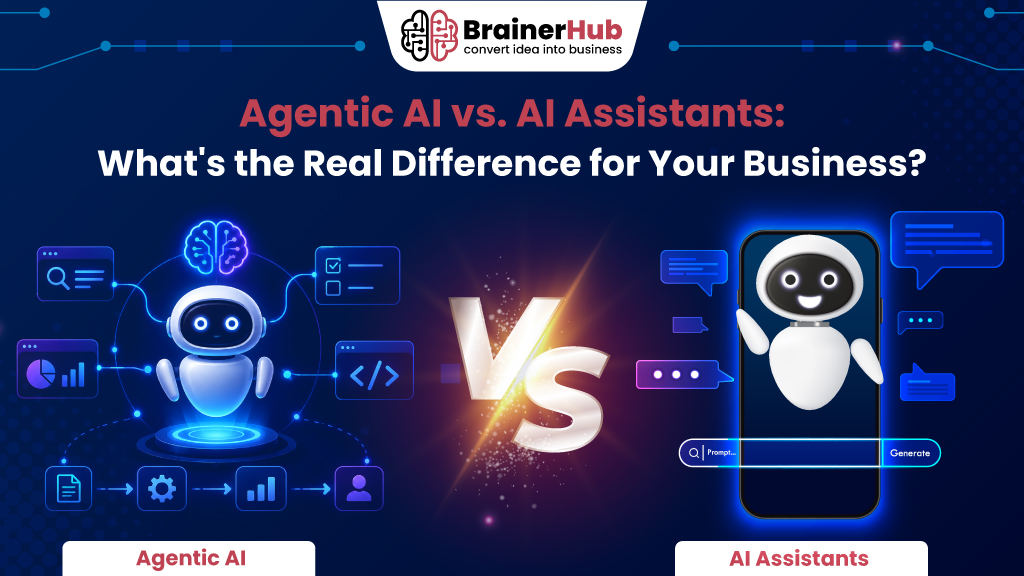
Agentic AI vs. AI Assistants
AI Assistants help people work faster by responding to prompts, answering questions, generating content, and supporting decision-making. Agentic AI takes a significant step further by autonomously planning, executing, and optimizing tasks to achieve business goals with minimal human efforts. While AI Assistants act as intelligent helpers, Agentic AI systems function more like digital workers capable of carrying out entire workflows.
Introduction
Artificial intelligence is entering a new phase. Over the last 2-4 years, businesses have rapidly adopted AI Assistants to help employees write content, generate code, summarize information, analyze data, and improve productivity. These tools have proven valuable because they make knowledge work faster and more accessible.
However, a new category of AI is now attracting significant attention across industries: Agentic AI.
Unlike traditional AI Assistants that wait for instructions, Agentic AI systems are designed to pursue objectives, make decisions, coordinate actions, and execute tasks across multiple systems. This shift represents one of the most important developments in enterprise AI adoption.
For business leaders, the question is no longer whether AI can generate content or answer questions. The real question is whether AI can actively help run business processes.
Understanding the difference between AI Assistants and Agentic AI is becoming essential for organizations planning their AI strategy over the next few years.
The Evolution of Business AI
To understand Agentic AI, it helps to look at how business AI has evolved.
The first wave of AI adoption focused primarily on automation. Businesses used rule-based systems and robotic process automation (RPA) to eliminate repetitive manual tasks.
The second wave introduced generative AI and AI Assistants. These systems could understand language, generate content, answer questions, and help employees complete tasks more efficiently.
Today, we are entering a third wave where AI is becoming increasingly capable of acting independently. Instead of merely assisting employees, AI systems can now analyze situations, formulate plans, make decisions, interact with software platforms, and complete complex workflows. This transition from assistance to autonomous execution is what defines Agentic AI.
What Is an AI Assistant?
An AI Assistant is designed to support human users. Whether it’s helping a marketer create content, assisting a developer with code generation, or enabling customer support teams to answer inquiries more quickly, AI Assistants operate within a human-led workflow.
The user remains in control. The assistant waits for instructions, processes requests, and provides outputs based on the information available.
For example, if a sales manager asks an AI Assistant to summarize customer feedback, the AI generates the summary. The manager then decides what actions should be taken based on that information.
The assistant contributes intelligence but does not take ownership of outcomes. This distinction is important because most AI deployments today still rely heavily on human decision-making.
What Makes Agentic AI Different?
Agentic AI introduces a fundamentally different operating model. Instead of focusing on individual tasks, Agentic AI focuses on achieving objectives.
When given a goal, an Agentic AI system can determine which actions need to be performed, execute those actions, evaluate results, and adjust its approach if necessary.
Imagine a customer support department receiving hundreds of support tickets each day. An AI Assistant might help agents draft responses.
An Agentic AI system, however, could categorize tickets, prioritize urgent cases, retrieve customer information, suggest solutions, escalate issues when needed, monitor resolution times, and continuously optimize workflows without requiring step-by-step instructions.
In this scenario, AI is no longer simply assisting employees. It is actively participating in business operations.
This ability to pursue goals rather than respond to requests is what separates Agentic AI from traditional AI Assistants.
|
AI Assistants |
Agentic AI |
|
Wait for instructions |
Pursue objectives autonomously |
|
Help people perform tasks |
Perform tasks and complete workflows |
|
Productivity-focused |
Outcome-focused |
|
Human-led |
AI-led with human oversight |
| Best for individual knowledge work |
Best for end-to-end business process automation |
The Real Business Difference: Productivity vs Outcomes
Many discussions about AI focus on technical capabilities. However, businesses should focus on outcomes.
AI Assistants primarily improve productivity they help employees complete tasks faster, reduce repetitive work, and improve access to information.
For example:
- Marketing teams create content faster.
- Developers write code more efficiently.
- Customer support teams respond more quickly.
- Managers generate reports in less time.
These improvements can create significant value across an organization. Agentic AI, however, targets a different objective. Instead of helping people perform work faster, it aims to complete work itself. The focus shifts from productivity gains to operational outcomes.
For example, rather than helping a logistics manager analyze delivery delays, an Agentic AI system may identify bottlenecks, coordinate alternative routes, notify stakeholders, and update delivery schedules automatically.
This distinction is likely to define the next stage of enterprise AI adoption.
A Practical Example: Sales Operations
Consider how both technologies might be used within a sales organization.
An AI Assistant can help sales representatives:
- Draft outreach emails
- Summarize meeting notes
- Prepare proposals
- Analyze customer interactions
These capabilities save time and improve productivity.
An Agentic AI system could take the process much further. It could monitor CRM data, identify high-potential prospects, generate personalized outreach campaigns, schedule follow-ups, track engagement, prioritize leads, and notify sales teams when intervention is required.
In this scenario, employees focus on relationship building while the AI manages much of the operational workflow. The business impact is substantially different, One improves efficiency, The other transforms how work is performed.
Why Agentic AI Is Generating So Much Attention
The excitement surrounding Agentic AI stems from its potential to address a long-standing limitation of enterprise software. Traditional software executes predefined instructions.
Human workers coordinate the process, Agentic AI introduces a layer of intelligence capable of adapting to changing circumstances. This means businesses can potentially automate processes that previously required human judgment. Areas such as customer service, supply chain management, procurement, financial operations, compliance monitoring, and manufacturing quality management are increasingly being explored as opportunities for Agentic AI deployment.
As AI reasoning capabilities continue to improve, organizations are beginning to envision AI systems that can operate as autonomous members of a business team rather than simply tools used by employees.
Does Agentic AI Replace AI Assistants?
No. In reality, most businesses will use both. AI Assistants and Agentic AI solve different problems. AI Assistants remain highly effective for creative work, collaboration, communication, research, and decision support.
Agentic AI is better suited for structured workflows, repetitive business processes, operational coordination, and autonomous execution.
A modern enterprise may use AI Assistants to empower employees while simultaneously deploying Agentic AI systems to automate back-office operations, customer workflows, and process management.
Rather than competing technologies, they are increasingly becoming complementary components of a broader AI ecosystem.
Challenges Businesses Should Consider
Despite the excitement surrounding Agentic AI, successful implementation requires careful planning.
The more autonomy businesses give AI systems, the more important governance becomes.
Organizations must consider:
Data Quality
AI systems are only as effective as the information they receive.
Security and Privacy
Autonomous systems often interact with sensitive business data and customer information.
Governance and Accountability
Organizations need clear policies regarding AI decision-making and oversight.
Integration Complexity
Agentic AI typically requires connections with CRM platforms, ERP systems, databases, APIs, and business applications.
Human Oversight
Even highly capable AI systems require monitoring and validation.
Organizations that address these challenges early are more likely to achieve successful outcomes.
Which Approach Is Right for Your Business?
For organizations beginning their AI journey, AI Assistants often provide the fastest path to value.
They require relatively low implementation effort, deliver immediate productivity gains, and help employees become comfortable working alongside AI technologies.
Organizations seeking deeper operational transformation may benefit from Agentic AI.
Businesses with complex workflows, high transaction volumes, and repetitive decision-making processes are often best positioned to realize significant returns from autonomous AI systems.
The most successful companies will likely adopt a combination of both approaches, using AI Assistants to augment employees and Agentic AI to automate processes that consume valuable time and resources.
The Future of Business AI
The shift from AI Assistants to Agentic AI represents more than a technological evolution. It represents a fundamental change in how businesses think about work itself, For decades, software has acted as a passive tool waiting for human direction, Agentic AI introduces the possibility of software that actively works toward business objectives. While widespread adoption will take time, the direction is becoming increasingly clear. Businesses are moving from AI that answers questions to AI that executes actions, Organizations that begin exploring these capabilities today will be better positioned to build competitive advantages as AI technologies continue to mature.
Conclusion
The difference between Agentic AI and AI Assistants ultimately comes down to one concept: assistance versus autonomy. AI Assistants help people work more efficiently, while Agentic AI systems are designed to achieve outcomes by planning, executing, and adapting actions independently. As organizations continue investing in artificial intelligence, understanding this distinction will play a key role in selecting the right technologies, maximizing ROI, and building a future-ready business.
Need Help to Build AI-Powered Business Solutions?
Whether you’re exploring AI Assistants to improve productivity or evaluating Agentic AI to automate complex workflows, choosing the right strategy is critical. At BrainerHub, we help businesses design, develop, and deploy AI-powered applications tailored to their operational goals. Contact our team to discuss your AI requirements and discover how intelligent automation can drive efficiency, scalability, and long-term business growth.