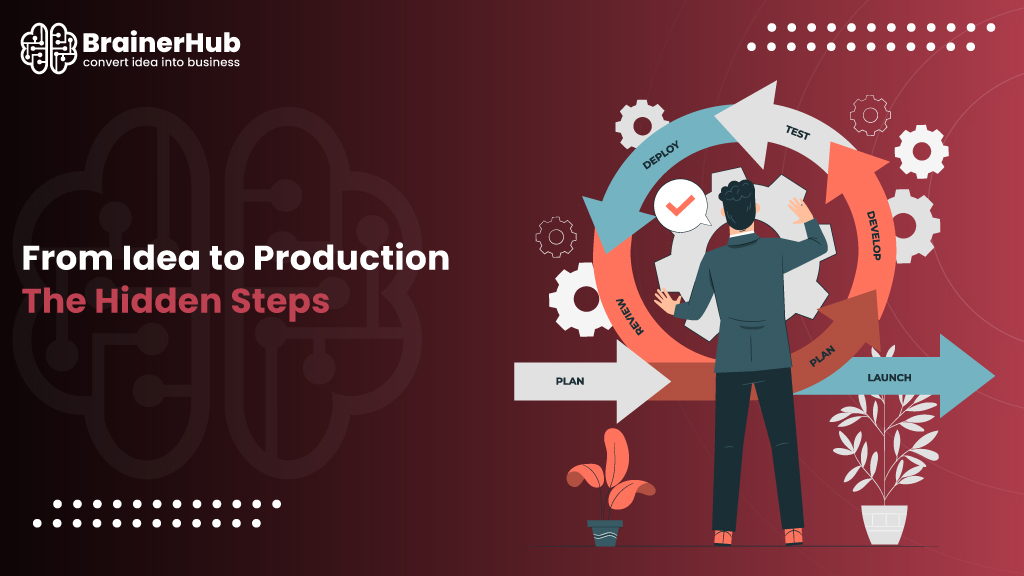
Most articles make software development sound simple. Come up with an idea, hire a few developers, push code, launch. In reality, moving a product from concept to production is a long chain of invisible steps that determine whether the final product succeeds or collapses. These steps are often skipped, underestimated, or ignored entirely by early teams. But they decide quality, speed, cost and user experience long before a single line of code is written.
This blog breaks down the steps that rarely get mentioned but make the difference between a product that thrives and a product that burns cash.
Understanding the Problem Before Building Anything
Founders often rush into development assuming the idea is clear. In most early builds, the real problem is not the technology but lack of clarity. You need to define the user, the job they are trying to get done, the environment where they will use your product, and the exact pain you want to remove. Without this alignment, teams spend weeks building features the user never asked for. Proper discovery avoids rework, saves cost, and lets you build the right thing the first time.
Converting the Idea into a Functional Blueprint
A clean idea still needs translation into something a development team can actually build. This is where product flows, acceptance criteria, edge cases and the complete user journey are documented. It is often the most important step in avoiding scope creep. A blueprint ensures that designers, developers and stakeholders interpret the idea the same way. It also prevents surprises during development because everything is defined upfront.
Designing for Real Users, Not Just Beautiful Screens
Great UI is not decoration. Every decision your user interface makes affects conversion, trust and engagement. Before writing code, designers must validate user paths, ensure information is placed logically, remove friction and guarantee clarity. This stage also decides accessibility, responsiveness and interaction feedback. Strong design reduces engineering rework later and makes your product feel polished even in early releases.
Choosing the Right Architecture from Day One
A poor architectural choice is one of the biggest reasons startups fail to scale. Quick fixes look cheap but become extremely expensive when your user base grows. Architecture decides how your app handles concurrency, API load, security and modularity. You need to choose the right frameworks, database models, caching strategies and deployment patterns to avoid technical debt. Good architecture makes development faster instead of slowing it down.
The Real Coding Phase: What Actually Happens
Most blogs simply say the developers start coding. The reality is a coordinated process of writing reusable components, handling edge cases, implementing authentication, securing APIs, optimizing queries, writing tests and integrating services. This phase is where quality shows. Clean code reduces future costs and makes scaling painless. Poor code leads to delays, failures and unpredictable bugs right before launch.
Integration, Testing and Breaking Things on Purpose
A product that “works” on a developer’s machine means nothing. Real testing checks performance, load behavior, browser differences, device compatibility, data flows and user interactions. Teams intentionally try to break the product to find weaknesses. This stage exposes hidden issues that could crash during real usage. Without strong QA, your product becomes fragile the moment real customers touch it.
Deployment, Monitoring and Post Launch Stability
Launching is not the end. It is the beginning of another hidden stage. You need CI pipelines, observability tools, logging, error tracking, server monitoring and real-time performance feedback. These systems ensure that issues are spotted instantly rather than after customers complain. Strong monitoring keeps you ahead of failures and protects your users’ experience.
Continuous Improvement After Real User Feedback
After launch, user feedback will show what matters and what doesn’t. Teams must adjust features, refine flows, improve performance and remove everything users don’t need. Continuous iteration keeps the product relevant and competitive. The biggest mistake founders make is assuming the launch version is final. Successful products evolve constantly.
How BrainerHub Helps You Through These Hidden Stages
Most development partners jump straight into coding. BrainerHub doesn’t. We guide you through every hidden stage that makes a product successful. This includes discovery, user flows, architecture planning, pixel perfect UI, strong engineering practices, automated testing, CI/CD setup, secure deployments and post launch support. You do not just get developers. You get a complete product team that ensures your idea becomes a stable, scalable and production-ready product.
Do you have a project in mind? Talk to the experts.
Get in Touch
We’d love to resolve your queries with personalized assistance.
Contact us
Our Office
D-101/102/501/601 Titanium Square Building, Near Thaltej Cross Road, Sarkhej - Gandhinagar Highway, Ahmedabad, Gujarat 380059